
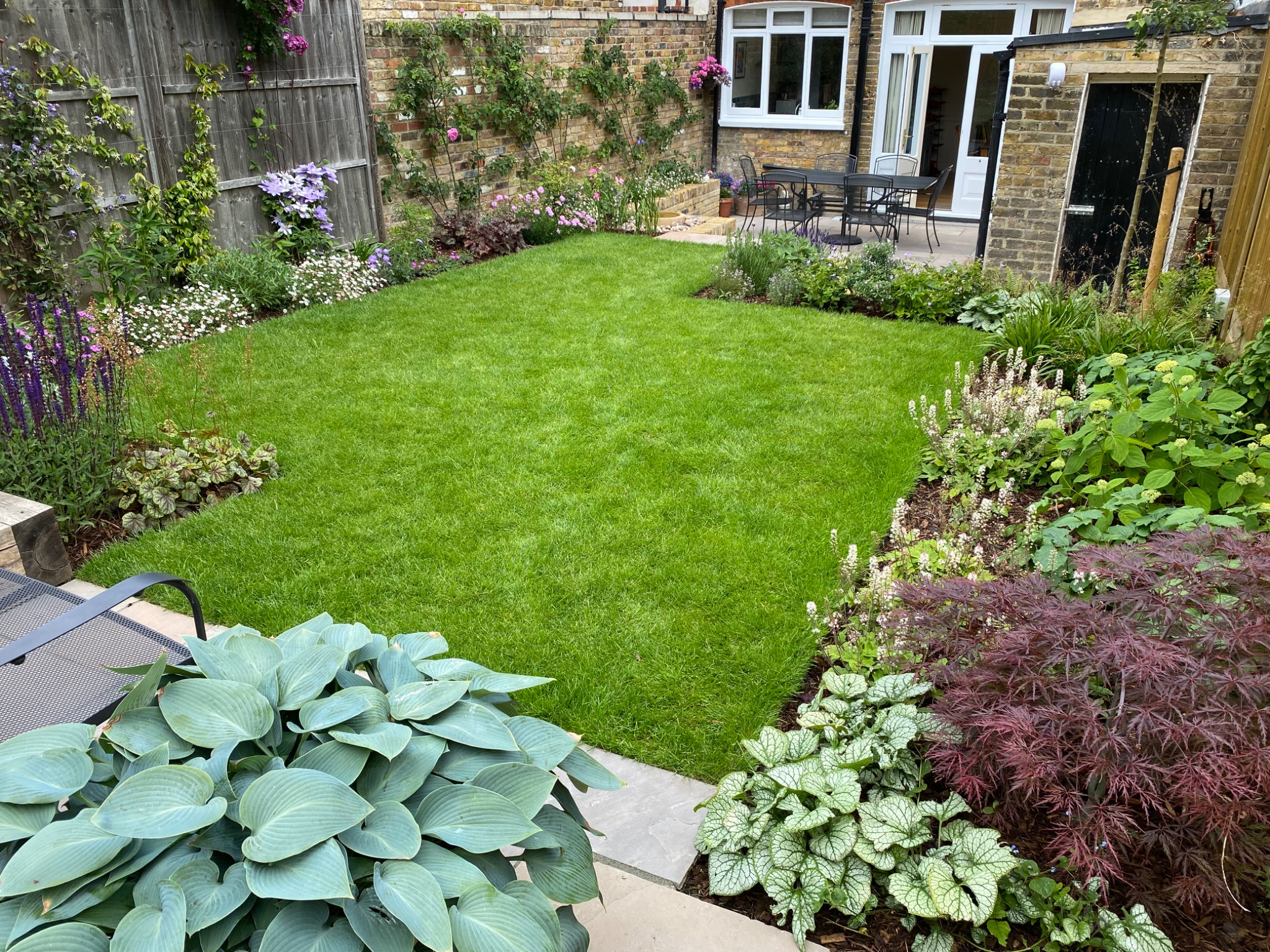
The lawn is often showing us what is happening below
Grass is the visible surface, so naturally it receives most of the attention when a lawn starts to struggle. But turf is only the uppermost part of a much deeper system.
Below it may be topsoil, subsoil, clay, compacted ground, previous construction layers or, in some London gardens, an entirely constructed landscape sitting above a basement or other structure.
Those conditions determine how easily water can enter the ground, where it can travel, how much moisture can be retained and how effectively roots can develop. Two lawns that look almost identical on the surface can therefore behave very differently during the same weather.
Clay can behave in two very different ways
Clay soil is common across many London gardens, and its relationship with water can be confusing.
When clay becomes wet, it can retain a considerable amount of moisture. Water can move through it slowly, particularly where the ground has also become compacted. As it loses moisture during prolonged dry weather, it can shrink, become hard and crack.
The wet winter lawn and the cracked summer lawn can therefore be two different behaviours of the same soil.
A path through grass gives us a simple example
One of the easiest ways to understand compaction is to look at a path that people have created simply by repeatedly walking across grass.
The surrounding lawn may drain reasonably well, while the line receiving regular foot traffic becomes harder and more compacted. After rain, puddles can remain along that route even when the ground immediately beside it is already beginning to recover.
The soil type has not necessarily changed from one side of the path to the other. What has changed is its structure.
Repeated pressure has reduced the spaces within the soil through which water and air can move. It is a small and visible example of something that can happen across a much larger area during construction.
Construction can create the same effect on a much larger scale
A finished garden can hide almost everything that happened while it was being built. Ground may have been excavated. Materials moved repeatedly through the site. Pallets may have remained in one place for weeks. The same access route may have carried thousands of journeys backwards and forwards.
Later, topsoil can be placed over those areas and turf laid on top. The garden becomes green again. But the structure of the ground underneath may still carry the footprint of construction traffic.
A puddle on a well-used path through grass is therefore a useful small-scale comparison for what repeated pressure can do across a whole garden.
Good topsoil does not automatically mean good ground
It is entirely possible to have good-quality topsoil at the surface while still having difficult conditions below it.
If a relatively shallow layer of good soil sits over heavily compacted ground, water moving through the topsoil eventually reaches what is underneath. Roots do too.
New turf can improve the appearance immediately. But new turf does not create new ground beneath it.
But not every difficult London garden is built on clay
Clay is an important part of the story in many London gardens. It is not the explanation for every lawn that struggles with water.
Increasingly, we also work with gardens where the ground beneath the finished landscape is not natural ground in the traditional sense at all. One particularly interesting example is a garden constructed above a basement or another built structure.
With dense development across London and properties making greater use of space below ground, this is a condition we now encounter more often.
A garden above a basement is a different kind of ground
In a conventional garden, we can usually think about water continuing down through layers of natural ground, even if that movement is sometimes slow or restricted. Above a basement, that assumption may no longer apply.
There can be a waterproof structure below the garden. Soil depth may be deliberately constructed and limited. Drainage has to work within a designed system. Water cannot simply continue travelling downward indefinitely.
At the surface, some symptoms can look surprisingly familiar: a lawn may remain excessively wet, another area may dry very quickly, plants may struggle despite apparently good soil, and water may collect in places that do not immediately make sense.
The symptom can resemble a problem we see in a clay garden while the reason behind it is completely different.
The same symptom can require a completely different solution
Imagine two lawns with water remaining on the surface after heavy rain. In the first garden, the lawn may sit directly above compacted clay. In the second, it may be part of a constructed landscape above a basement.
Both clients can describe exactly the same problem: My lawn is waterlogged. But underneath those lawns are two very different systems.
Two gardens can show us almost identical symptoms while requiring completely different thinking underneath.
This can change the design of the whole garden
Gardens above basements and other structures are particularly good examples of why landscape design and construction cannot always be separated.
Soil depth matters. Plant choice can be influenced by available rooting depth. Drainage has to be considered as part of the constructed system. Water storage matters. Finished levels matter. The weight and build-up of hard surfaces can matter.
In this kind of garden, the ground itself is effectively part of the construction. The design has to respond to that from the beginning.
A puddle tells us something — but not enough
A puddle tells us that water is not moving as we would like. It does not tell us why.
In one garden, the reason may be compacted clay. In another, construction traffic may have created a dense layer below otherwise good topsoil. Elsewhere, levels may naturally direct water into one area. And in another garden, the lawn may sit above a basement where water movement is governed by an entirely different constructed system.
The visible result can look almost identical. The ground underneath it — and therefore the solution — can be completely different.
Summer can reveal another part of the story
Cracks appearing during a hot summer may be associated with clay shrinking as it loses moisture. But a lawn struggling in summer does not automatically tell us that clay is underneath it.
A relatively shallow constructed soil profile can also dry quickly. Different soil depths across a garden can cause one area to behave differently from another. Compacted ground can restrict rooting, leaving grass less able to make use of moisture deeper in the soil.
Winter shows us how the garden responds when water is abundant. Summer shows us how it responds when water becomes limited. Looking at both can tell us considerably more about what is happening underneath.
More water in summer is not always the whole answer
When a lawn struggles during a prolonged dry period, irrigation is an obvious response. But supplying more water does not necessarily address the reason a particular lawn is drying so badly.
Water still has to enter the soil. The soil needs to retain a useful amount of it. Roots need access to that moisture. And in a constructed garden, the entire build-up has to manage that water appropriately.
The ability of the ground to receive, store and release water is part of the resilience of the lawn itself.
The healthiest lawn is not only about the grass
A good lawn obviously needs appropriate turf or seed and sensible ongoing care. But its long-term performance begins deeper.
Rooting depth matters. Soil structure matters. Compaction matters. The relationship between topsoil and the ground underneath matters. And sometimes the structure underneath the entire garden matters.
The grass may be where the problem becomes visible. It is not necessarily where the problem begins.
One lawn can tell us a story across the whole year
There is useful information in seeing the same garden in different seasons. A wet area in January may identify where water naturally wants to collect. A path holding puddles can show us the effect of repeated compaction. A struggling area in July may reveal where soil dries particularly hard or where rooting depth is limited.
A lawn that is waterlogged in winter and struggling in summer is not necessarily suffering from two opposite problems. And it does not automatically mean the garden has London clay.
Before deciding that the answer is more drainage, more topsoil, more irrigation or simply new turf, we first need to understand what kind of ground we are actually dealing with. Because two gardens can look almost identical from above. Underneath, they may be completely different.
White Edge Thought
THE GRASS SHOWS US THE PROBLEM. THE GROUND UNDERNEATH OFTEN EXPLAINS IT.
Is this something you’re seeing in your garden?
Thank you for your feedback.