
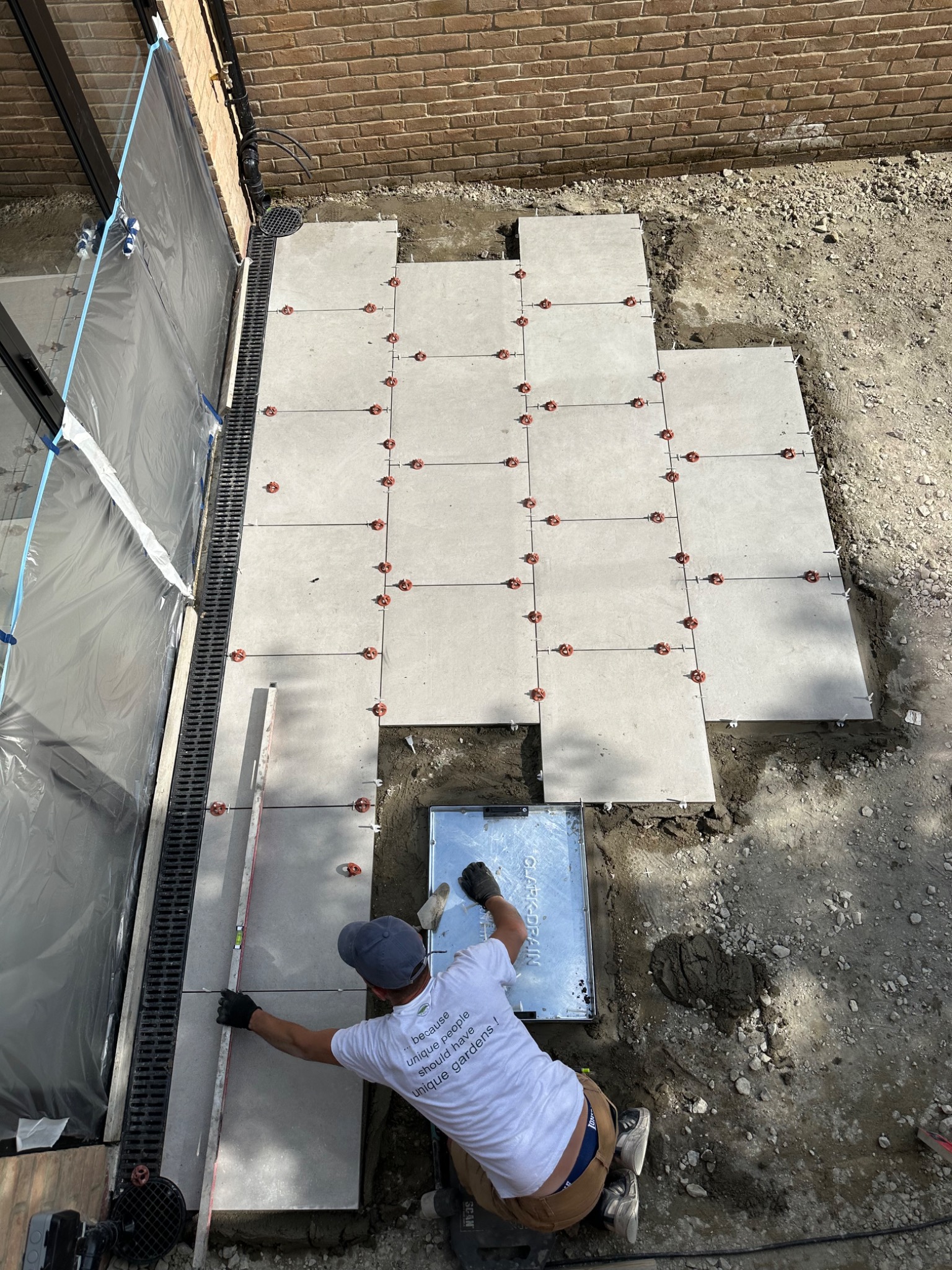
The Surface Often Reveals A Problem That Started Below
When paving begins to move, joints open or water starts collecting in a low area, attention naturally goes to the visible surface. But the paving may simply be showing us a problem that began lower down.
The finished slab is only the final layer of a construction. What supports it has to deal with the ground beneath, loads above, water and seasonal movement.
Every Garden Starts With Different Ground
London gardens can contain clay, made-up ground, old foundations, roots, rubble and areas that have been disturbed by previous construction. Two neighbouring gardens can therefore require different preparation even when the same paving is being installed.
Small movement below can eventually become visible above as cracked joints, low slabs, changed falls or movement at an edge.
Compaction Is Part Of The Construction
A base is not simply about putting enough material underneath paving. How that material is placed and consolidated matters. Poorly consolidated ground can continue settling after the visible work has been completed.
Groundwork can therefore take longer than the visible laying of the paving. Much of the patio has already been built before the first finished slab goes down.
Backfilling After Major Excavation
We have worked on projects where gardens need to be reinstated after basement construction. In those situations, a substantial area around the new structure may have to be backfilled before the garden can be rebuilt.
Backfilling is not simply putting soil or material back into the hole. A deep excavation cannot be filled to the required level in one operation and then expected to behave like ground that has never been disturbed.
The ground needs to be rebuilt progressively, layer by layer, considering the material being used and properly consolidating each stage before the next. This becomes particularly important when paving, steps, walls or other constructed elements will eventually sit above it.
If deep backfill remains loose, settlement can continue long after the garden looks finished. Later, that movement may appear as dropped paving, opened joints, altered levels or movement in elements built above. The visible problem can therefore arrive months or years after the decision that caused it.
Edges Are Part Of The Structure
The middle of a patio receives most of the visual attention, but its edges are important too. Where paving meets planting, walls, steps or another surface, the construction needs to remain supported and the intended levels need to be maintained.
Weakness at an edge can gradually work back into an otherwise sound paved area.
Levels Begin Before The Paving
Falls and finished levels cannot be treated as a final adjustment. They influence excavation depth, base construction, steps, thresholds, planting areas and the route water will take through the garden.
By the time the paving is ready to be laid, many of those decisions should already have been made below it.
More Material Does Not Automatically Mean A Better Base
More sub-base is not automatically better groundwork. Excavation depth, the material placed back, compaction and edge support have to suit the ground, the paving above and the loads the area will actually carry.
A patio used for foot traffic asks something different of the ground from a driveway, a raised step or paving rebuilt over deep backfill. The preparation should reflect that difference.
Problems Can Take Time To Appear
Ground movement is not always immediate. A patio may pass through rain, drought and winter before a weakness becomes obvious. That delay can make a surface problem appear unrelated to the original groundwork even when the two are directly connected.
When a serious base problem does occur, perfectly good paving may have to be lifted simply to reach the cause underneath.
Build From The Ground Up
The most attractive paving cannot compensate indefinitely for unsuitable preparation below it. The finish matters, but it can only perform as well as the construction supporting it.
For that reason, so much of a good patio is completed before the first finished slab is laid.
White Edge Thought
THE BEST PART OF A WELL-BUILT PATIO MAY BE THE PART YOU NEVER SEE.
Was this article useful?
Thank you for your feedback.