
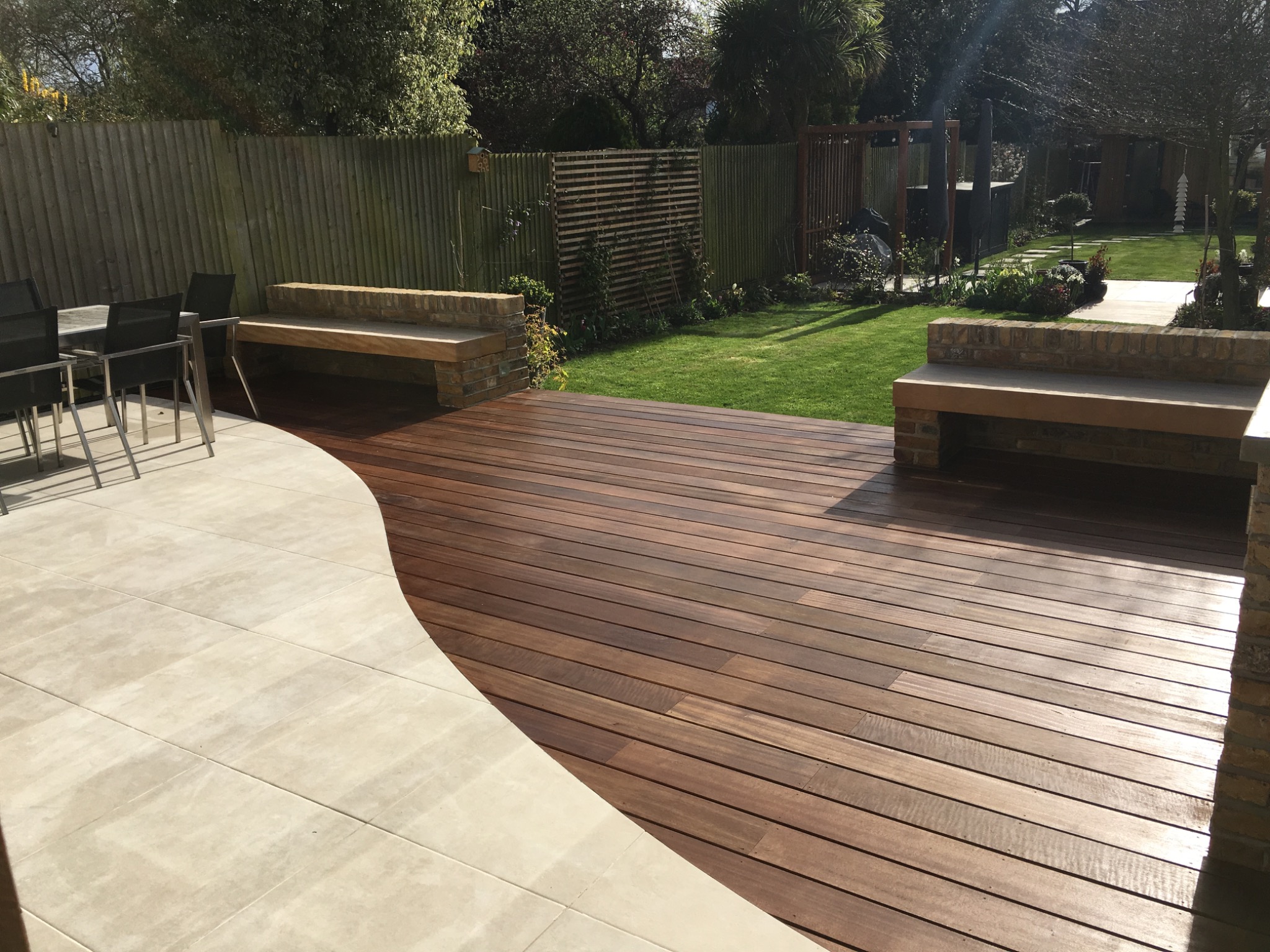
Timber Does Not Stay Looking New
Freshly installed timber has a colour and surface appearance that will change outdoors. UV light gradually alters the colour of timber and some species will move towards grey or silver tones if left to weather naturally.
That colour change does not automatically mean the timber is deteriorating. Appearance and structural condition are not the same thing.
Summer Is Also About Moisture Movement
Strong summer weather is not only about heat. Timber repeatedly gains and loses moisture. As moisture content changes, boards can expand, contract and show small amounts of natural movement.
The aim of good construction is not to stop timber behaving like timber, but to detail the deck so that normal movement does not become a problem.
Two Identical Decks Can Age Differently
A south-facing deck in open sun can experience very different conditions from the same timber in a shaded garden beneath trees and dense planting. One may dry quickly after rain while the other remains damp for much longer.
In practice, the environment around the deck matters just as much as the product name on the timber.
Ventilation Underneath Matters
What happens above a deck is only part of the story. One of the biggest influences on how timber decking performs over time is what happens underneath it.
Good ventilation beneath the boards allows moisture to escape and helps the timber dry after rain. A deck surrounded by good airflow can behave very differently from one built close to the ground or enclosed in a space where damp air remains trapped.
This becomes particularly important in shaded gardens, beside dense planting or anywhere the deck naturally takes longer to dry. For us, ventilation is therefore part of the construction of the deck, not something considered afterwards.
Timber Needs The Right Amount Of Room To Move
The gaps between decking boards are not simply a visual detail. Different timber products behave differently as moisture levels change. Hardwood and softwood do not necessarily require exactly the same approach, and the condition of the timber at the time it is installed also matters.
When we build decking, we consider the type of timber and the space it needs to move naturally as conditions change. This becomes especially important when decking is contained between other materials — for example between walls, paving, steps or raised structures.
Timber that has nowhere to move can begin putting pressure on the materials around it or on its own fixings. Equally, gaps that are inappropriate for the material can create other problems as the boards expand and contract.
The aim is to give it enough room to move without that natural movement becoming a problem — but not so much space that unnecessarily large gaps compromise the finished appearance of the deck, rather than to stop timber moving.
The right balance depends on the timber being used, its condition when installed and the environment in which the deck is being built. Good detailing has to accommodate the material while still producing a clean, considered finish.
Fixings Are A Small Detail With A Long-Term Job
Fixings have to remain outside through the same wet and dry cycles as the decking itself while continuing to hold boards securely. The type of fixing, the material it is made from and how it interacts with the particular timber can all influence how the finished deck ages.
Poorly chosen fixings can deteriorate, react with certain timbers or leave unwanted marks and staining around fixing points. A fixing may be one of the smallest components in a deck, but there can be hundreds of them across the finished surface.
Planting Changes The Environment Around A Deck
Planting rarely stays the size it was when the deck was built. As trees, climbers and surrounding planting mature they can increase shade, reduce airflow and deposit leaves or pollen on the surface.
A deck that was once open and quick to dry can therefore become a much more sheltered environment several years later.
Pots And Furniture Create Local Conditions
Large planters, small pots and furniture can shade individual areas of decking and sometimes trap moisture beneath them. When objects remain in the same position for long periods, the timber beneath can weather differently from the exposed surface around it.
Where possible, water from pots should have a route away and raising containers slightly can help air circulate beneath them.
Cleaning Is Part Of Maintenance
Leaves, soil and organic debris can hold moisture against the timber, particularly in shaded areas and between boards. Keeping those areas clear can be just as relevant as applying a maintenance product.
Maintenance does not always mean coating the deck. Sometimes it simply means allowing the construction to continue drying and ventilating as it was intended to.
Treatment Should Have A Reason
Some owners want timber to weather naturally while others prefer to retain more of its original colour. Both can be valid choices depending on the timber and the desired finish.
The important point is to understand what a treatment is intended to achieve rather than assuming that every deck needs the same product every summer.
Look At Behaviour, Not Only Appearance
We pay more attention to persistent dampness, unusual movement, damaged boards, deteriorating fixings or changes in the environment around the deck than to colour change alone.
Because we return to some of the gardens we have built for regular or seasonal maintenance, we can see how these details behave over time rather than only on installation day. A deck does not have to look new to be healthy. The aim is for normal ageing to remain normal and for preventable conditions not to shorten its working life.
White Edge Thought
TIMBER DOES NOT NEED TO STAY NEW TO CONTINUE DOING ITS JOB.
Was this article useful?
Thank you for your feedback.