
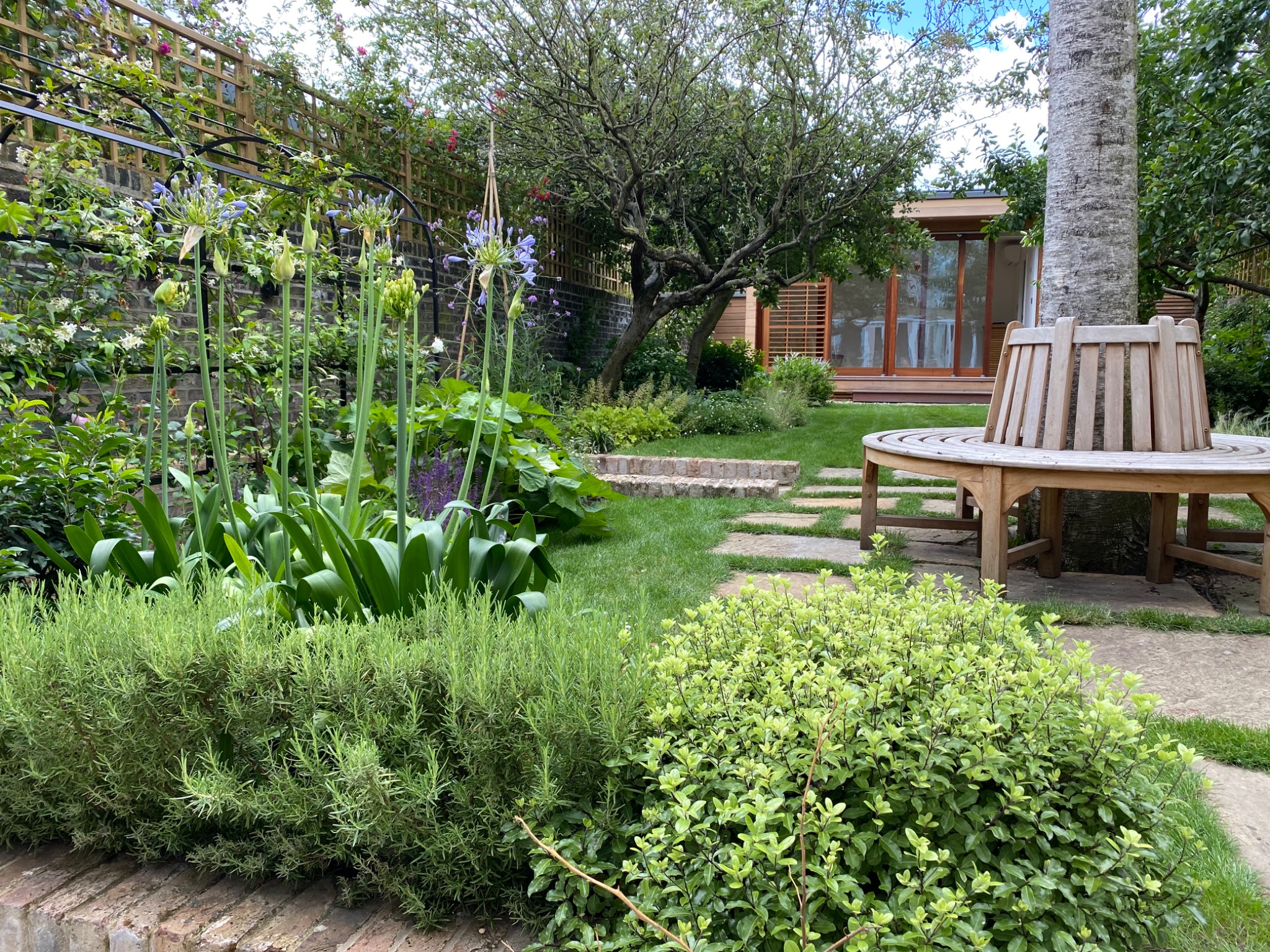
A finished garden only tells part of the story
On completion day, paving is clean, timber is new and planting has only just begun to establish. It is an important moment, but it is also only the beginning. Long-term quality is often decided by work that is already hidden: the ground beneath paving, the structure below decking, foundations, retaining walls, soil preparation and the way different parts of the garden have been connected.
Completion day is a poor test of a garden. The more useful test comes after wet winters, dry summers, established planting and years of ordinary family use.
Water should be considered before construction
Water is one of the things we think about before the visible finish goes down. Where will rainwater travel? How quickly can the ground absorb it? What happens at changes of level and beside buildings? Not every garden needs a complicated drainage system, but every garden benefits from understanding how water is likely to behave.
We do not start by assuming every garden needs the same drainage detail. We look at where the water can go, what the ground is doing and how the finished levels will change its route.
Materials are supposed to change
Timber changes colour. Paving develops marks and weathering. Joints, soil and planting all respond to seasons and use. The important distinction is between natural ageing and premature failure.
A material does not need to remain looking new to continue performing properly. What matters is whether it was selected and detailed for the place in which it has to live.
Where materials meet matters
Many long-term problems do not begin in the middle of a material. They begin at an edge or junction: where paving meets a wall, where decking meets another hard surface, where soil levels meet timber, or where water is expected to pass from one area to another.
These details can appear small on a drawing, but in the finished garden they often decide whether movement, moisture and maintenance can be managed properly.
A garden is not a controlled environment
We often continue caring for gardens that we originally built, either regularly or seasonally. That gives us something construction alone cannot provide: the opportunity to see how the same garden actually develops over a number of years.
Problems can occur naturally. One plant may begin suppressing another. A tree may develop differently from what was expected. One part of the garden may remain damp while another dries quickly. No two gardens behave exactly the same because light, shade, moisture, soil, surrounding trees, neighbouring buildings, wind and airflow all influence what happens.
A label can tell us the expected size of a tree, but it cannot instruct nature exactly how that tree will grow in one particular London garden. Those figures are useful expectations, not guarantees. The same principle applies to construction materials.
Identical decking in an open sunny position and beneath dense planting can age very differently. Paving beneath trees experiences different conditions from the same paving in an open area. Leaves, pollen, shade, moisture, pots, surrounding vegetation and everyday use all affect surfaces.
What is underneath it matters. How it was built matters. But where it lives matters too.
Maintenance is not automatically evidence of failure
Timber weathering, paving becoming marked, organic material collecting in shaded areas or plants outgrowing their original space are not automatically construction failures. Gardens are living outdoor environments and they require appropriate care.
The useful question is whether we are looking at a construction problem or a garden naturally changing and needing maintenance. Returning to gardens we have built helps us understand that difference and also shows us how decisions made during construction perform years later.
Maintenance can be designed in from the beginning
Long-term thinking also means considering how the garden will eventually be maintained. Can drainage points be reached? Can a damaged decking board be replaced without dismantling half the structure? What happens to water beneath pots and planters? What will mature planting do to access, airflow and shade?
We would rather answer those questions while the structure is still open than discover the answer years later with finished work in the way.
Think about the garden in five years
A useful way to judge a design is not only to ask how it will look on completion day, but how it should work in five years. By then the planting will be larger, materials will have weathered and the way the family uses the garden may have changed.
A garden that has been built with those changes in mind has a much better chance of ageing naturally rather than simply getting older.
White Edge Thought
A GOOD GARDEN IS NOT ONLY BUILT FOR THE DAY IT IS FINISHED. IT IS BUILT FOR THE YEARS THAT FOLLOW.
Was this article useful?
Thank you for your feedback.