
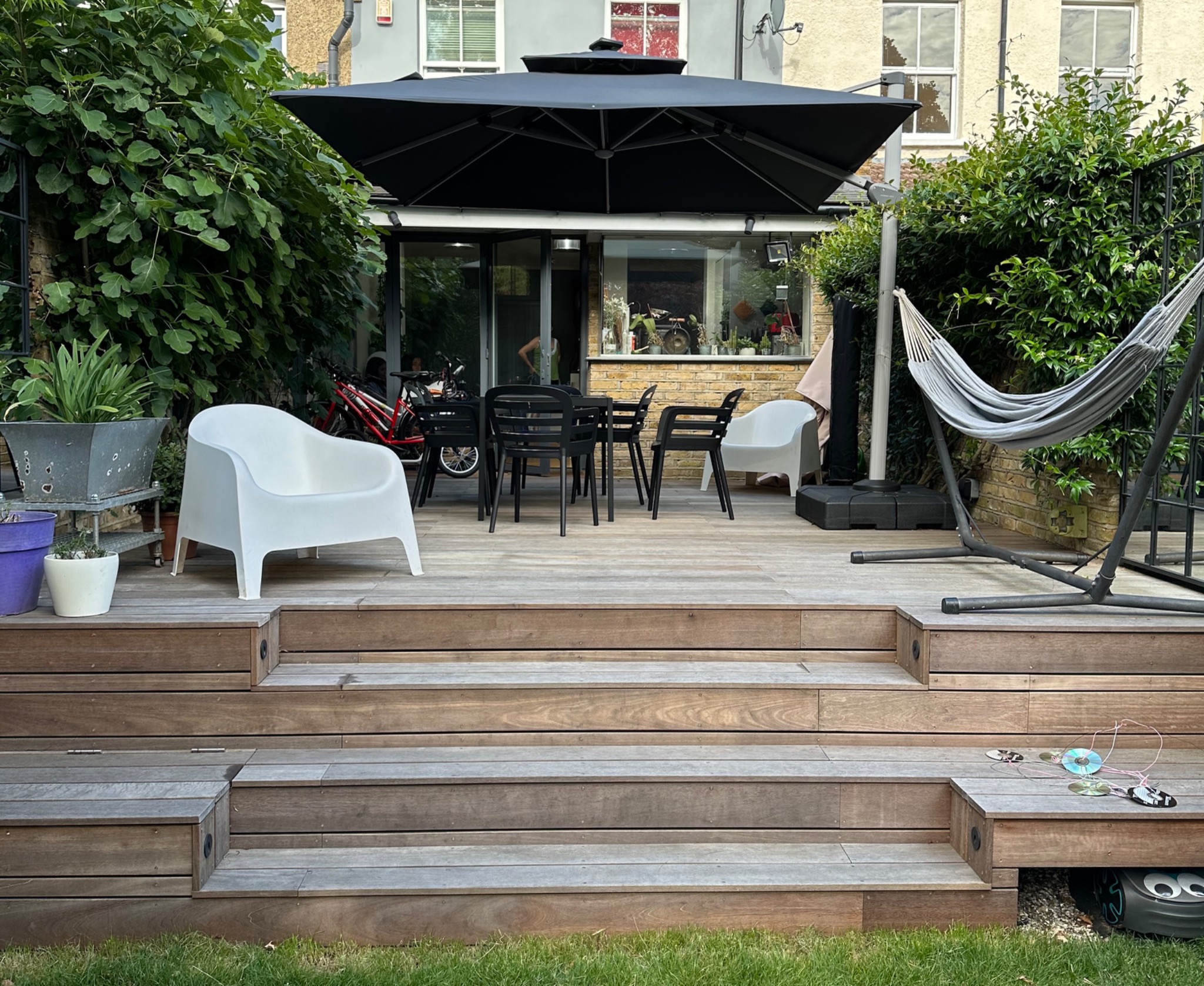
A Sunny Garden Is Not Always A Comfortable Garden
Patios and terraces are no longer simply places for a table and a few chairs. They can become outdoor dining rooms, kitchens, play areas and places where families spend several hours at a time.
A patio that receives uninterrupted sun from late morning until evening may sound ideal when it is being designed in winter. During a very hot summer afternoon, it can feel completely different. Good design can provide both sun and somewhere to escape it.
Materials Experience The Sun Too
Different garden materials absorb and release heat differently. Dark surfaces in exposed positions can become noticeably hot. Timber changes as it moves repeatedly between wet and dry conditions. Planting beds can dry faster, and containers can experience particularly demanding conditions.
Location is therefore part of the material choice. The same surface can feel completely different in open sun and beneath established planting.
Some Materials Can Become Part Of The Heat Problem
A material can appear perfectly suited to the way a garden will be used and still behave very differently during periods of strong summer sun.
Artificial grass is a good example. From one point of view, it can seem particularly practical for an area where children play — it is consistent, does not become muddy in the same way as a natural lawn and can cope with regular use.
But in direct summer sun, artificial grass can become extremely hot. On particularly warm days the surface can become uncomfortable to walk on, especially barefoot, which can change how usable that part of the garden actually is at exactly the time of year when people expect to use it most.
This does not automatically make artificial grass the wrong material. It shows why material selection should consider more than appearance and maintenance. We also need to ask where the material will be used, how much direct sun it will receive and who will actually be using that space.
Trees Can Be Part Of The Architecture
One of the most effective ways of creating shade can also be one of the most natural: trees. A well-positioned tree can eventually provide shade over a seating area while still allowing light into other parts of the garden.
But trees grow. The shade pattern that exists when a garden is completed may be very different five or ten years later. That makes planting part of the long-term architecture of a garden.
Pergolas Can Do More Than Create A Feature
Pergolas are often treated primarily as visual structures, but their practical role can be just as important. Depending on their design and position, they can help create a transition between open sunlight and a more sheltered part of the garden.
Climbing plants can change that environment further over time, creating increasing shade as they mature. A pergola may begin as a relatively open structure and gradually become a much more sheltered space.
Shade Does Not Always Need A Permanent Structure
Creating shade does not necessarily mean adding another permanent structure to the garden. Pergolas and covered structures can be beautiful elements of a design, but they are also permanent and visually present throughout the year — including during months when additional shade may not be needed.
In recent years, we have increasingly considered other forms of shade during the design and construction process, even when they are not being installed immediately. A garden awning is a good example.
If we know where an awning or another retractable shade system may eventually be positioned, its requirements can be considered while the surrounding garden is being designed and built. Something that may appear to be an accessory later can still influence decisions made much earlier.
Compared with a freestanding parasol, these solutions can often feel much more integrated into the garden. They do not necessarily require a large base occupying valuable patio space, and when they are not required they can be retracted or removed rather than remaining as a permanent feature.
Shade itself can become seasonal. During summer, an awning or carefully considered shade element can change the character of a seating or dining area, almost becoming part of the garden's summer design. During cooler months, it can disappear again and allow more light into the same space.
The important part is not that every garden should have an awning, pergola or particular type of sun protection. It is that the possibility of shade should be considered early enough that the garden can accommodate it properly later.
Shade Can Reduce Pressure On Planting
Plants need light, but that does not mean every plant benefits from the strongest possible sun throughout the day. Areas of partial shade can retain moisture differently from completely exposed beds, and plants sheltered from intense afternoon sun may experience less stress during prolonged hot periods.
A useful garden usually needs variation: places that take the sun and places where people and planting can get out of it.
Mature Gardens Create Their Own Climate
Trees develop larger canopies, hedges become denser and climbers cover structures. A garden can gradually begin creating its own small environments. One corner may remain cool and damp while another only a few metres away becomes hot and dry.
We see this particularly clearly in gardens that we continue maintaining after construction. The conditions several years later are not necessarily the same conditions that existed when the garden was built.
Shade And Water Are Connected
Exposed ground and containers can lose moisture quickly during hot weather. Creating appropriate shade will not remove the need for irrigation or good soil, but it can influence how quickly parts of the garden dry.
As summers place greater pressure on gardens, how we manage sunlight and how we manage water increasingly become connected design questions.
We Should Design For The Hottest Afternoon Too
Where would you sit at three o'clock on a very hot afternoon? Where could children play without being in uninterrupted sun? Would there still be somewhere comfortable to eat outside? What happens to the planting during a prolonged dry period?
Sometimes the answer may be as simple as preserving an existing tree, positioning a seating area differently or leaving space for planting that will eventually provide shelter. The important thing is that shade is considered before the garden is finished, rather than discovered later as something that is missing.
A Good Garden Offers Choice
The future of garden design is not about choosing between sunny gardens and shady gardens. It is about creating gardens that offer both.
There should be places where sunlight is welcomed and places where it can be escaped. There can be open areas and sheltered ones, and those relationships can change as the garden matures.
Shade is no longer simply the part of the garden where the sun does not reach. Shade can be something we deliberately design.
White Edge Thought
A GOOD GARDEN DOESN'T NEED SUN EVERYWHERE. IT NEEDS THE RIGHT PLACE TO BE AT THE RIGHT TIME OF DAY.
Was this article useful?
Thank you for your feedback.