
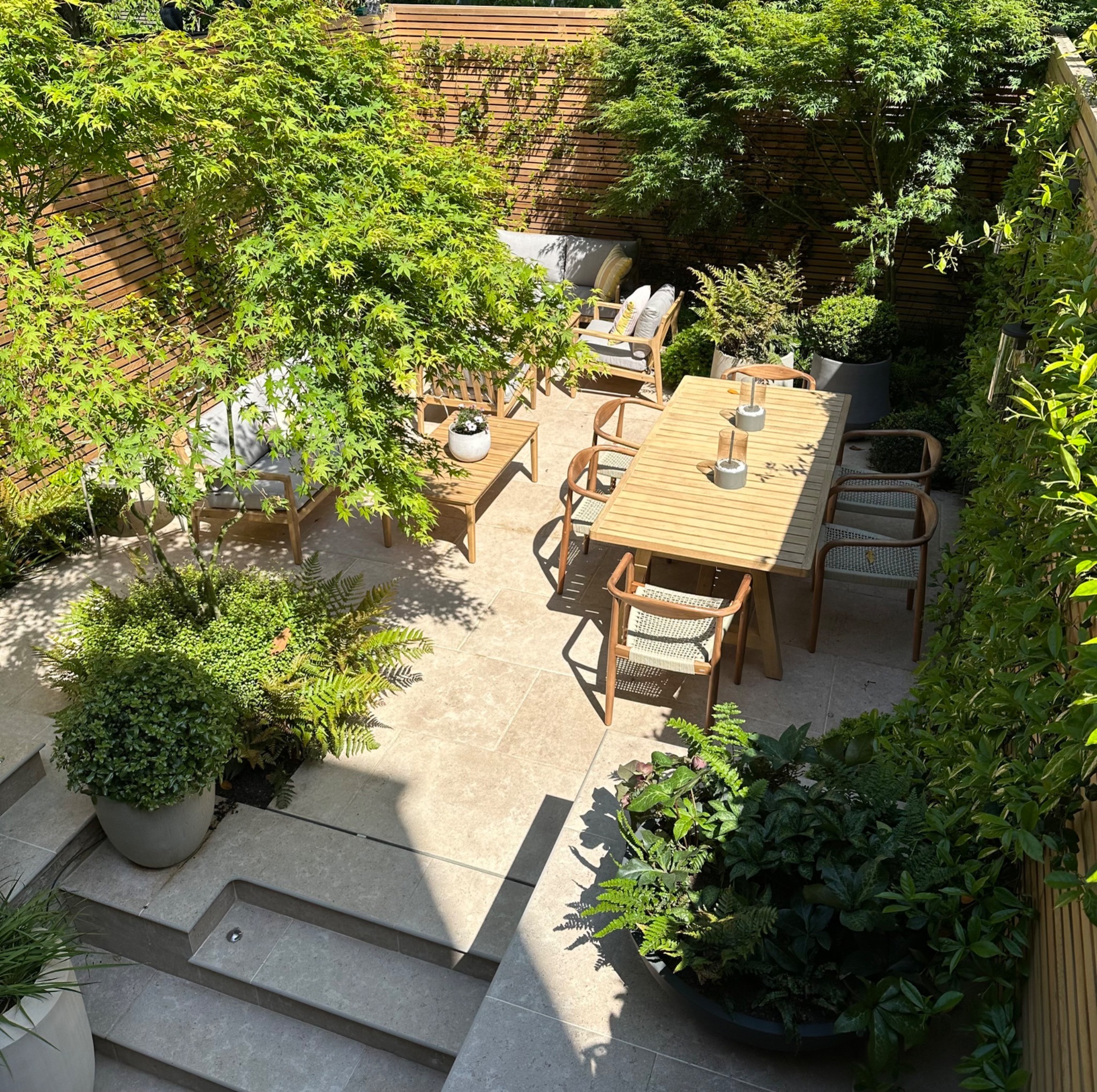
A garden is designed at one moment in time, but it doesn't stop changing when the design is finished. Plants grow. Trees get bigger. Families change. Children grow up and stop using the play area. Furniture changes. Materials age. Sometimes the house changes too, and suddenly the garden has to respond to something that wasn't part of the original design at all.
Changes to the house can create new requirements too. An extension, a basement or a new family arrangement may ask something of the garden that was never part of the original design.
A garden that looks very different ten years after it was built is not necessarily a garden that has failed. Sometimes it has simply lived.
LONDON'S GARDENS ARE CONSTANTLY CHANGING
The same need for ongoing care is visible across London. London has more than 3,000 publicly accessible parks and green spaces, covering around 18% of the city. These landscapes are not built once and then left alone. They are continually maintained, adapted and managed as the city around them changes.
Grass needs cutting, trees need managing, planting changes, paths wear, facilities become outdated and the way people use public spaces changes over time.
London Assembly research has also noted that local-authority parks budgets have fallen by around 8% since 2008, while London's population has increased by more than 15%. The figures are very different from those of a private garden, but the principle is similar: a landscape needs to be looked after and sometimes changed as the world around it changes.
SOMETIMES THE GARDEN CHANGES BECAUSE OF THE PEOPLE
There are gardens that we built many years ago and have continued to return to and maintain. Over the years, the children have grown up, play areas have been removed, the sandpit has turned into a herb garden, planting has been adjusted and, occasionally, a new idea or trend has found its way into the garden.
Returning year after year means we get to know both the garden and the people who use it. The original structure remains recognisable while planting and smaller elements are adjusted. That is what we hope a good garden will do: give people enough of a foundation to change without having to start again.
SOMETIMES THE MATERIALS CHANGE FIRST
I have another good example from a client whose garden we had been maintaining for years. They eventually sold the house and moved to another property, but they kept our maintenance service and we moved with them to look after their new garden.
The new garden had three terraces. The lower two were decked, while the upper terrace had a lawn and beds, a summerhouse and a huge tree at the back. The decking was not the best quality and was leaving splinters in the children's feet, so, at the client's request, we replaced it with composite decking.
We continued maintaining the garden until the house was eventually sold. Some time later, the new owners asked us to take on the maintenance and make a few tweaks around the garden. By then, the two lower terraces had been changed from decking to paving, but the steps joining the different levels were still the ones we had originally built.
Different parts of a garden have different lifespans. A material can be replaced without replacing the structure around it, and a new owner can change something because it no longer suits the way they use the garden while retaining elements of the original design that still work perfectly well.
SOMETIMES THE HOUSE OUTGROWS THE GARDEN
Around eight years ago, we built a garden to a designer’s plan and stayed with it, maintaining it and adjusting the planting as it developed. Around two years ago, the client decided to build a huge basement, which meant losing most of the garden.
The trees were protected where possible. Some had to be taken out, but instead of being lost, they were kept, maintained and cared for at our site so that they could be taken back later. While the construction is going on, we are still maintaining what is left of the garden, including the trees and boundaries.
Once the basement is finished, we will continue the work. It will be a new start for the garden, but with a little touch from the past.
NOT EVERYTHING NEEDS TO BE REPLACED
There is sometimes a tendency to think that when a garden no longer works perfectly, the answer is to start again. That is not always necessary. Sometimes the original structure is still good. The levels work, the paths are in the right places, the boundaries are sound and the proportions still make sense. What has changed is how the garden is being used, or what has happened to the planting and materials over time.
In those situations, a garden can often be adjusted rather than replaced. A planting scheme can be changed, a tired material replaced, a play area turned into something else, or a section of paving renewed without disturbing the structure beneath it. The skill is knowing what needs to change and what is worth keeping. That becomes much easier when you know the history of the garden.
MAINTENANCE IS PART OF THAT STORY
This is one of the reasons long-term maintenance can be so valuable. Maintenance is often thought of as keeping a garden exactly as it is. In reality, it can be about understanding how the garden is changing and deciding what should happen next.
When you have been returning to the same garden for years, you also know what has changed and what has remained. You know which tree was planted small and has now become a major part of the garden, which planting area was originally designed for children to play around, which material has already been repaired once and which part of the garden has never caused a problem. That history becomes part of the garden itself.
LEAVING ROOM FOR CHANGE
A good design has to work when it is first built, but it also helps if it gives the garden enough structure to evolve afterwards. That might mean allowing space for a tree to mature, creating planting that can be adjusted over time, choosing materials that can be repaired rather than replacing everything, or simply building something well enough that the next owner can adapt it rather than remove it.
A garden is not a photograph. It is something that continues to develop. But life is not always predictable. People change, circumstances change, and sometimes the garden reaches a point where adapting what is already there is no longer enough. Sometimes the garden simply needs a restart — a chance to begin again from zero. That is part of its life too.
White Edge Thought
A GARDEN DOESN'T HAVE TO STAY THE SAME FOREVER.
IT CAN ADAPT AND STILL REMAIN TRUE TO ITSELF.
Was this article useful?
Thank you for your feedback.