
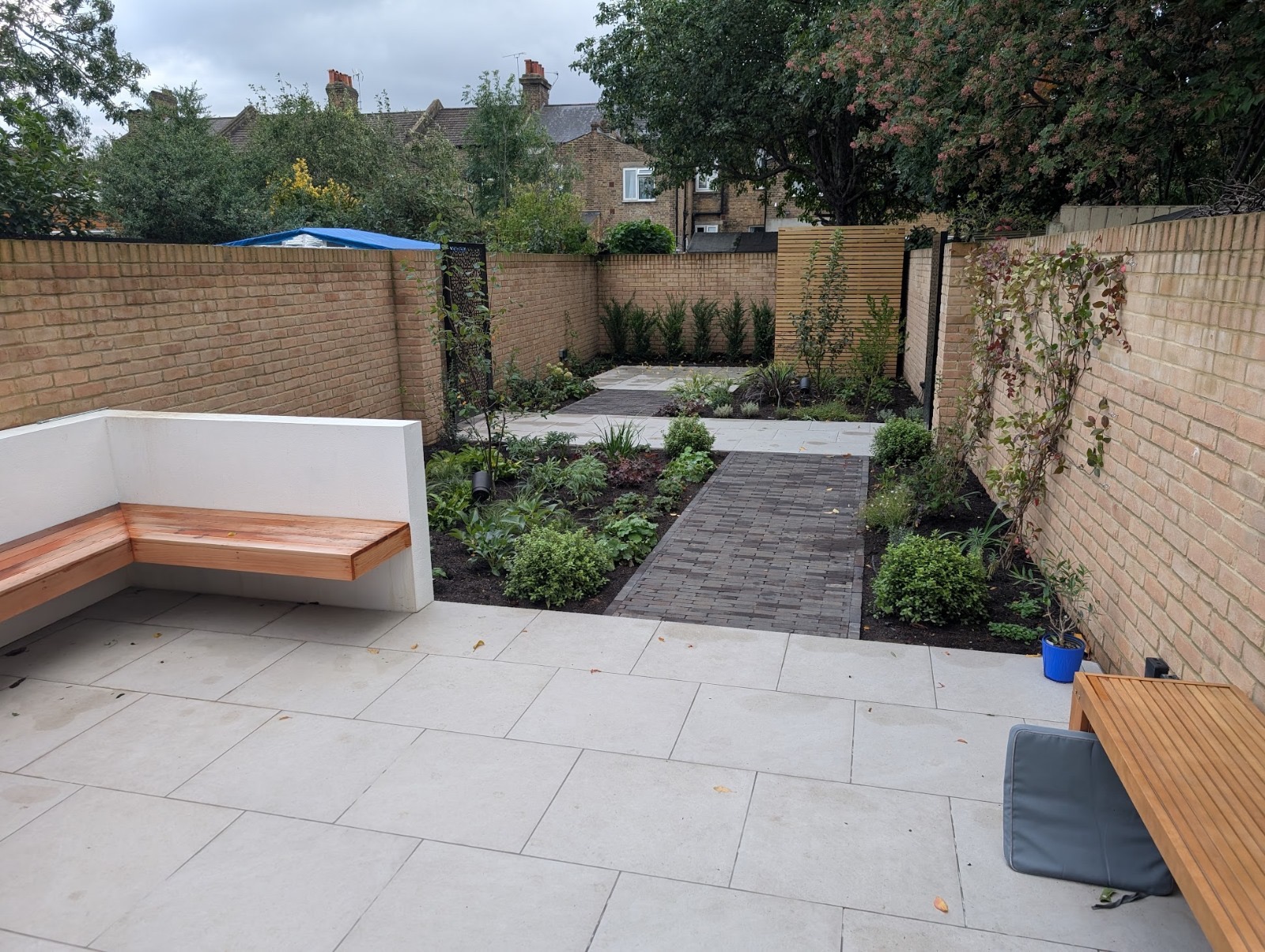
A junction is never just a line on a drawing
Indoors, two materials can often meet in a relatively controlled environment. Outdoors, the same junction has to deal with rain, soil, roots, moisture, temperature changes, frost, organic debris and years of use.
For that reason, the places where materials meet deserve as much thought as the materials themselves.
Where paving meets planting
A hard surface beside a planting bed looks simple, but the edge is doing real work. If paving is not properly contained, bedding and aggregate can gradually mix with soil. Roots can extend beneath the paving and moisture conditions can differ dramatically on either side.
The visible line may be only a few millimetres wide. The construction beneath it can determine whether that line stays clean or becomes a point of movement and deterioration.
Decking edges live in a difficult place
Board ends close to soil, planting or trapped organic matter can remain damp for much longer than open timber. Leaves and soil gradually accumulate in places that looked perfectly clear when the garden was completed.
Good detailing gives timber the opportunity to dry rather than assuming the surrounding garden will remain exactly as it was on installation day.
Even the fixings can change the finish
Screws, nails, brackets and corner beads are small components, but the wrong material can corrode outdoors and leave rust marks on adjacent finishes. Certain timbers can also release oils, tannins and other extractives that stain nearby paving, render or masonry.
The junction therefore includes more than the two materials we can see. It includes the fixings, support and separation hidden behind them.
Not every junction should disappear
Sometimes a gap, movement joint or deliberate separation is exactly what allows two materials to behave properly beside one another. Trying to make every transition visually seamless can remove the space needed for drainage, movement or drying.
The best junctions are often the ones nobody notices because they continue doing their job quietly.
What experience changes
Years of construction and maintenance — including learning from our own mistakes — have made us pay more attention to edges. Problems often reveal themselves there first.
When materials meet well, the detail tends to disappear. When they do not, the meeting point can become the most noticeable part of the whole surface.
White Edge Thought
The smallest detail in a garden can decide how the largest surface grows old.
Was this article useful?
Thank you for your feedback.