
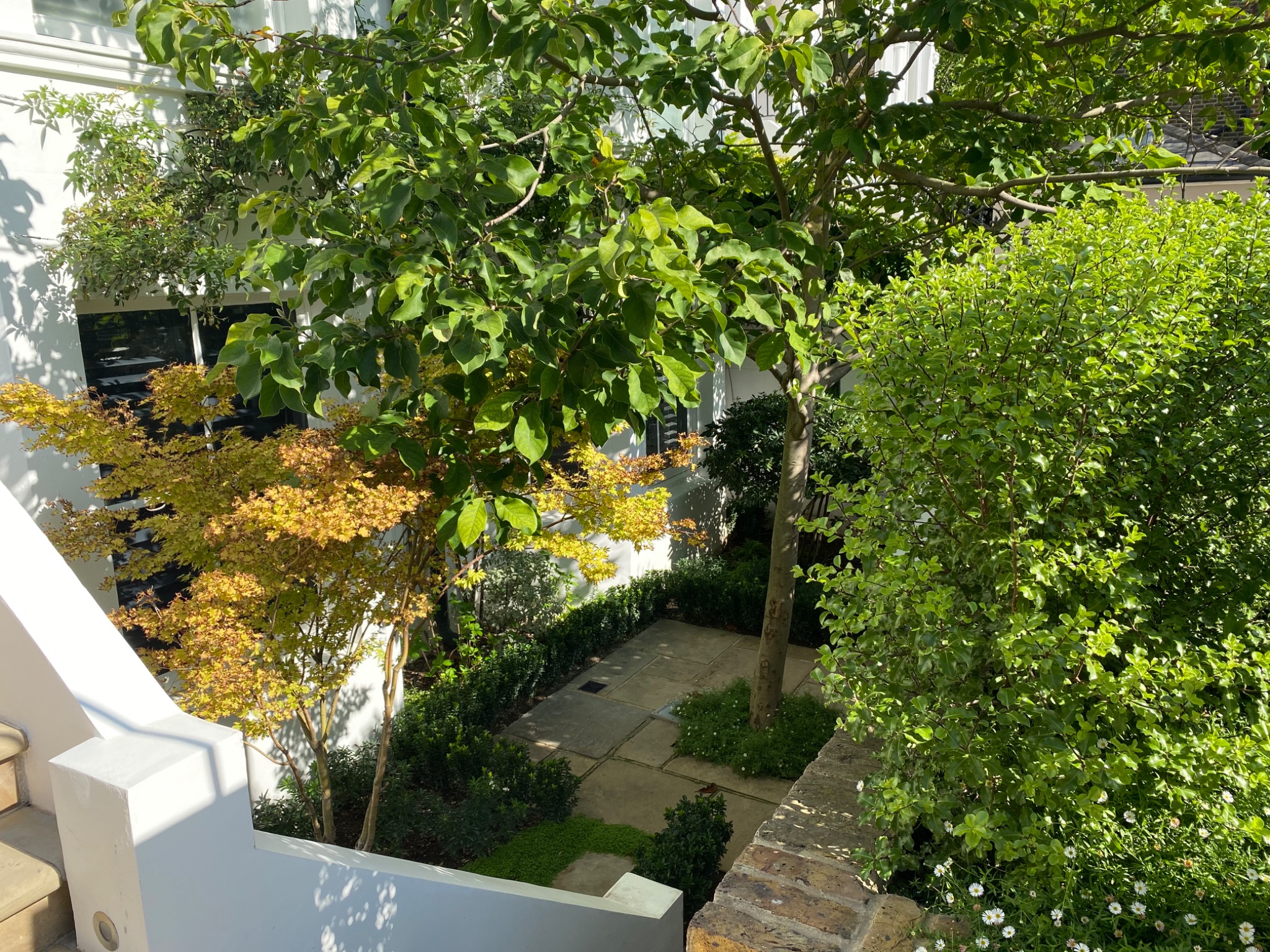
Completion is not maturity
There is a moment at the end of almost every garden construction project. The tools disappear. The paving is cleaned. The furniture arrives. The planting is watered. Photographs are taken. And everyone naturally thinks: Finished.
From a construction point of view, perhaps it is. But from the garden's point of view, almost everything has just started. Trees are small, hedges have gaps, climbers are low and planting has not filled the spaces deliberately left for it. Perhaps we have confused completion with maturity.
Some of Britain's greatest landscapes were designed for people who might never see them mature
Lancelot ‘Capability’ Brown redesigned hundreds of parks and estates during the eighteenth century. He moved earth, created lakes, opened views and planted trees that would eventually define them.
The National Trust notes that Brown's landscapes could take a century to reach maturity. People were making landscape decisions knowing that the fullest expression of those decisions might belong to another generation.
Imagine presenting that idea to a modern client
Imagine finishing a garden and saying: It should look really good in about 100 years. We probably would not get paid.
A London garden today cannot be compared directly with an eighteenth-century country estate, but the principle is worth keeping. A kitchen or bathroom can look finished immediately. A garden is different because one of its principal materials is alive.
The photograph has changed how we judge gardens
Instagram, Pinterest, property listings, design websites and before-and-after photographs have made the garden reveal part of how projects are presented. We do it ourselves.
But the photograph usually captures the garden when paving is spotless, timber is new and planting is neat. Without noticing it, we can treat that image as the finished garden when it may actually show the garden at its youngest.
Sometimes a newly planted garden should look slightly empty
A newly planted border can look underwhelming. The temptation is to add more and make it look complete immediately. But we are not planting a photograph. We are planting organisms with an expected mature size.
If everything is filled on Day One, the photograph may look better. Five years later, the garden may not. Sometimes the empty space in a new garden is not missing design. It is space deliberately left for the future.
When we leave, that can actually be the starting point
In our own work, we sometimes explain almost the opposite of the idea that the landscapers leaving means the garden is finished. When the hard landscaping is complete, this is the starting point — not the finish.
Plants establish, roots develop, hedges close gaps, climbers find structures and trees create shade. The contractor has left. The garden has started.
We sometimes build for something that does not exist yet
A pergola may look exposed because a climber is eventually supposed to travel across it. A young hedge may provide almost no privacy, but the soil preparation and spacing may have been planned around the hedge that will exist several years later.
A young tree may look too small beside a large terrace. Choosing a much larger mature tree simply to make the proportions work immediately, however, is not always the right — or even possible — answer.
Before asking what will fit in the garden, ask what will fit through the way in
Working in London gardens has taught us that access can influence a design far more than people realise. Many rear gardens can only be reached through the house; others have narrow side returns, tight passages, steps, basement access or restricted gates.
A mature tree may fit perfectly in its eventual position but its rootball, weight or canopy may make it impossible to get there. The same applies to oversized planters, long structural components and large pieces of stone. Before specifying something large, ask: Can we actually get it there?
Sometimes components can be assembled inside the garden, dimensions can be selected around the route, specialist lifting can help, or a younger tree can be planted and allowed to become mature inside the garden. We have to design for things we cannot yet see, while understanding the physical limitations of the place in which they will grow.
Some clients do want the garden to feel established from the beginning
None of this means that a new garden has to look young. Some clients have a very clear idea of what they want: larger trees, mature hedging, established planting and a garden that feels substantially developed from the moment construction is complete. We build gardens like this too.
If the client knows what they want — and understands the financial implications — our job is to find the best way of delivering it. That may mean mature specimens, larger plants, specialist access or lifting, more substantial planting areas, or adapting construction around what needs to arrive later.
But an instant result still has to work as a future garden. A mature plant does not stop growing because it already looks impressive. Its roots, eventual size, water requirements and relationship with surrounding plants still matter. The same applies to the materials around it.
There is nothing wrong with wanting a garden to feel established immediately. The important distinction is between creating maturity and pretending that time no longer matters. If a client has a clear vision, we will always try to build the garden they want, within the realities of the site and budget — without ignoring the nature of the materials, the needs of the plants, the limitations of the site and what all of them are going to do next. Because even a garden designed to look mature on Day One still has a Day Two.
And sometimes the garden changes the design for us
One plant may thrive while another struggles. A tree creates more shade. Children grow. Furniture moves. Three pots become twenty. A barbecue becomes an outdoor kitchen. Ten years later, the garden may be doing something nobody predicted exactly.
That does not necessarily mean the original design failed. A good design should be strong enough to allow the garden to evolve without falling apart.
Perhaps this is why established gardens can feel so different
An old garden that feels as though everything belongs is rarely the work of one moment. A mature tree, an older wall, a later hedge, an altered terrace and a climber that has slowly occupied a building can all belong together.
That quality is difficult to create instantly because what we are responding to is not simply design. It is design plus accumulated time.
Maybe this changes what a successful garden should be
Success should not necessarily mean that the garden looks best at handover. A better test is whether the construction gives it somewhere to go: enough room for trees, hedges and planting, and enough flexibility for parts of the garden to change without everything needing to be rebuilt.
Does the garden have the ability to become better with age? Ten years later, that may be the question that mattered most.
A garden is built towards a future state
A room is generally built towards a finished state. A garden is built towards a future state. We can complete the construction, levels, walls, paving, soil and planting — even use mature planting to make it feel established immediately — but eventually part of the project is handed over to weather, seasons, plants, people and time.
So when we finish a project, perhaps the better question is not only: Does it look finished? It is: What is this garden going to become?
White Edge Thought
When the hard landscaping is finished, the garden may only just be starting.
Was this article useful?
Thank you for your feedback.