
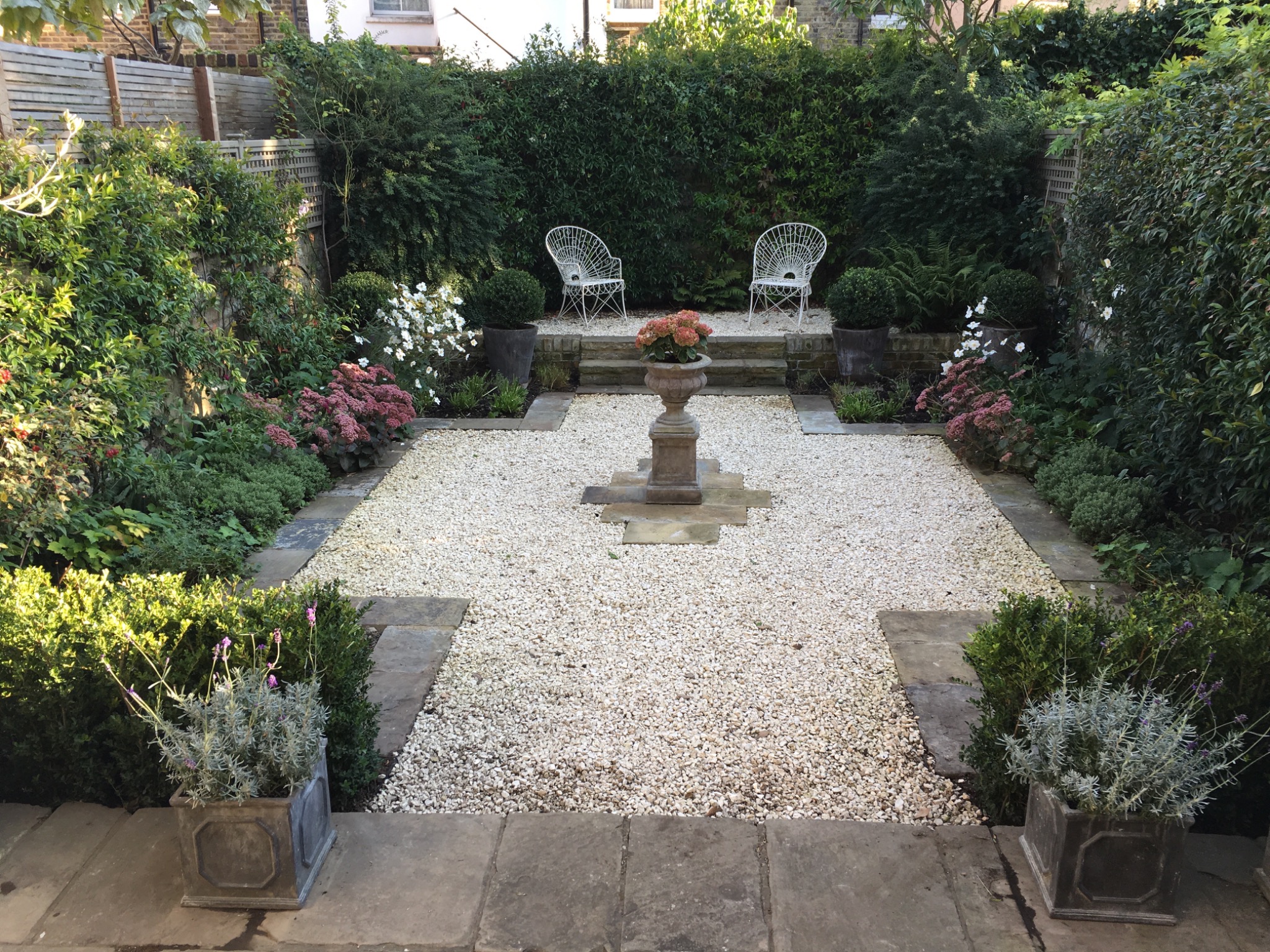
London has changed around its gardens
A single garden may seem insignificant when we think about rainwater across an entire city. But gardens do not exist independently.
Around them are roofs, roads, pavements, extensions, driveways and other hard surfaces. Water falling onto many of those surfaces has limited opportunity to soak naturally into the ground.
One garden will not solve London's relationship with rainwater. But thousands of gardens collectively represent a considerable area of land. The question is not whether we should stop building patios or remove every practical hard surface, but whether the rest of the garden can do more with the water that arrives there.
Drainage does not always have to mean removal
When we talk about drainage, it is easy to imagine a simple journey: rain falls, water reaches a drain, water leaves the garden. Sometimes that is exactly what needs to happen.
But drainage can also be about controlling the journey rather than simply shortening it. Where can water safely soak into the ground? Where could it be temporarily held? Could planting benefit from some of it? Could water move more slowly through one part of the garden before leaving another?
A garden can need less water and hold more water at the same time
There is an interesting contradiction in many gardens. During wet periods, we work hard to remove water. During dry periods, we bring water back into the same garden.
A planted area that can safely receive more rainwater during wet weather may retain moisture for longer afterwards. Soil with good structure can store water while still allowing excess water to move through it.
Holding water and waterlogging are not the same thing. The aim is to give useful water somewhere appropriate to go before deciding that it needs to leave the site, rather than to keep every drop.
Soil is part of the rainwater system
When thinking about rainwater, it is tempting to focus on visible drainage: channels, gullies, pipes and outlets. But one of the largest potential stores of water in a garden is already there: the soil.
Healthy, appropriately structured soil can receive and hold a significant amount of moisture while still allowing water to move through it. Compacted or heavily disturbed ground behaves differently.
Looking after the ground beneath planting and lawn areas can therefore be part of drainage planning too.
Hard landscaping and rainwater management do not have to be opposites
There is sometimes a tendency to divide gardens into two ideas: hard landscaping creates drainage problems, while planting solves them. Real gardens are more complicated than that.
A well-designed patio can be an entirely appropriate part of a garden. What matters is what happens to the water that reaches it.
The patio, lawn, planting, soil and drainage can be considered as parts of one water system rather than separate features.
Sometimes the balance is already part of the planning conversation
The balance between hard surfaces and planted or permeable areas is not always simply an aesthetic decision.
Across London, planning requirements and local policies can influence how much of a site can be covered by hard surfaces and how much should remain planted, permeable or otherwise capable of contributing to the wider landscape and water strategy.
A client may want a generous patio, a garden room, paths, seating areas and other practical surfaces. Each may make sense individually, but together they begin to change how much living and permeable space remains.
Those boundaries do not necessarily have to weaken the design. They can encourage us to think more carefully about proportion: how much hard surface is genuinely needed, where planting will have the greatest effect, which areas need to be impermeable and where another solution could work.
A successful garden does not need to choose between being practical and being planted. The challenge is to find the right balance for that particular site.
Not every garden should hold water in the same way
London gardens vary enormously. Soils differ. Levels differ. Some gardens sit higher than neighbouring properties and others lower. Buildings, basements, retaining walls and boundaries can completely change what is sensible.
The objective should never be to hold water simply because holding water sounds environmentally better. The objective is to understand where water can safely be useful and where it genuinely needs to be moved away.
Planting can become part of the infrastructure
Planting is usually discussed in terms of appearance, habitat, privacy, seasonality or atmosphere. But planting areas can also perform practical work.
Their soil can receive water. Plants use moisture. Their roots influence soil structure. A generously planted part of a garden can behave very differently from the same area covered by an impermeable surface.
Instead of treating rainwater as waste the moment it lands on a hard surface, we can ask whether part of the garden could make use of it.
Keeping rainwater can also mean using fewer resources
Water that is safely collected during wet periods can become a resource later.
If rainwater from roofs or other suitable surfaces can be stored and used for irrigation, some of the water the garden needs during drier periods has already arrived for free. That reduces reliance on mains water and becomes particularly useful during periods when restrictions on garden water use are introduced.
Storage needs to be considered intelligently. The amount of water available, the area collecting it, how quickly storage fills, how the water will be used and what happens when the storage is full are all part of the same system.
The aim is to connect rainfall with future demand. Managing rainwater well can help a garden become more economical with water as well as more resilient during dry periods.
The answer may be different during different kinds of rain
Not all rainfall creates the same challenge. A long period of moderate rain gives the ground time to respond differently from a short, intense downpour.
A garden may comfortably absorb normal rainfall but struggle when a large amount arrives in a very short period. Holding more rainwater does not mean pretending overflow will never happen. It means deciding what should happen first, what should happen next and where water should go when the garden has taken as much as it safely can.
We can design around water rather than add drainage afterwards
If rainwater is considered only after the patio, levels, planting areas and structures have already been designed, our choices are much narrower.
If it is considered earlier, water can influence the layout itself. A level might direct water towards planting rather than away from it. A lower planted area might have a deliberate purpose. A rainwater storage system could be incorporated before the finishes make access difficult.
Water management can be part of the garden rather than something added to it.
Perhaps the question is not how quickly water can leave
London gardens still need drainage. Buildings need protection. Patios need to function. Excess water needs somewhere safe to go.
What may be changing is the assumption that successful drainage always means removing rainwater from the garden as quickly as possible.
We can decide which water needs to leave, which can safely enter the soil, which can support planting, which can be stored and which may simply need to spend a little longer within the garden before moving on.
Perhaps the future question is not simply how quickly we can remove rainwater from a garden. It is how intelligently we can use the space, soil, planting and storage available to decide what should happen to that water next.
White Edge Thought
RAINWATER IS NOT ONLY SOMETHING A GARDEN NEEDS TO GET RID OF. IN THE RIGHT PLACE, IT IS SOMETHING THE GARDEN NEEDS.
Was this article useful?
Thank you for your feedback.