
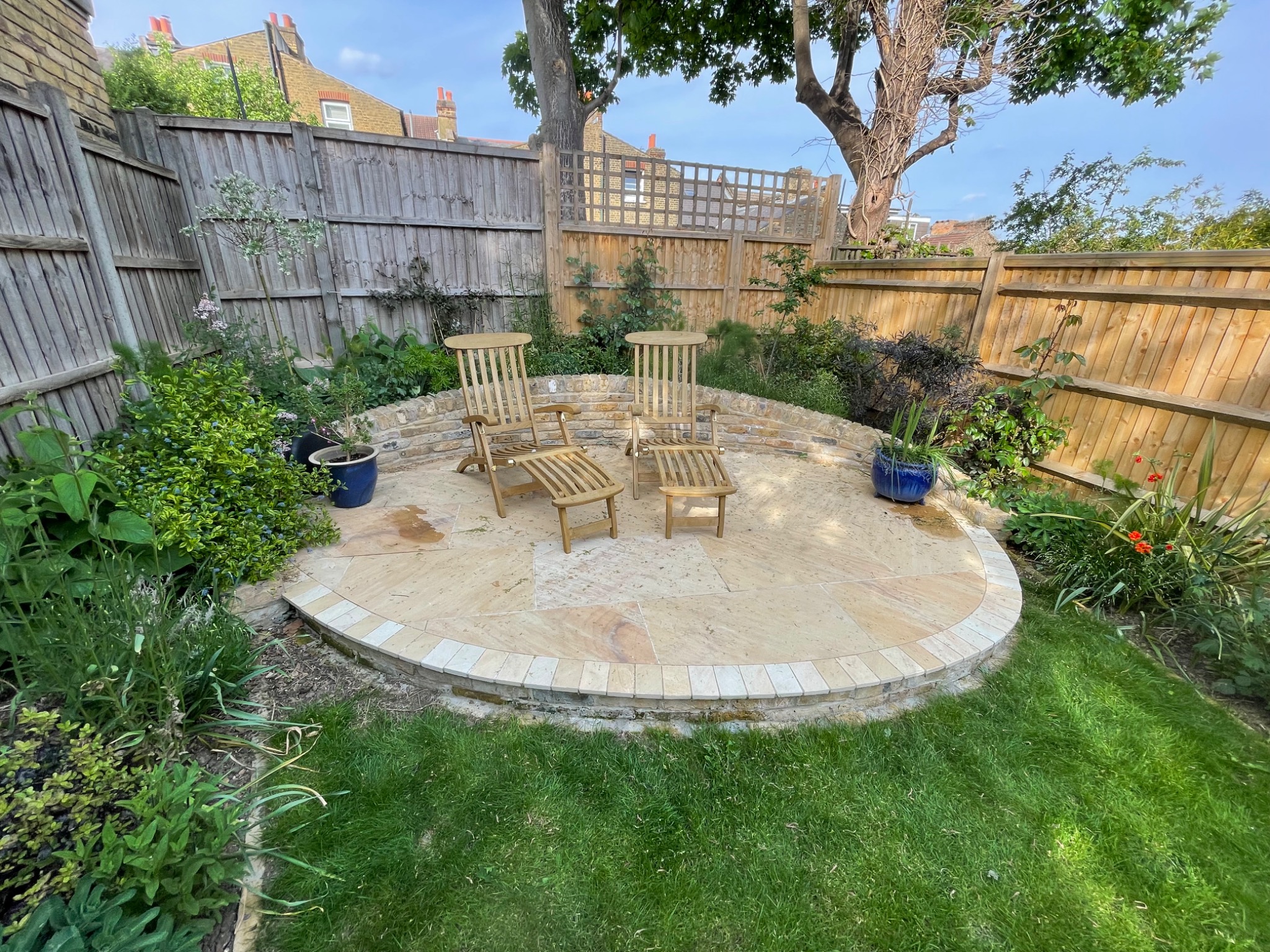
Sandstone was never manufactured to be identical
Unlike porcelain or other manufactured paving, sandstone was formed naturally over an enormous period of time. Its appearance comes from the sediments and minerals present when the stone was formed, as well as the conditions in which those layers developed.
Even within the same quarry, the stone does not exist underground as one perfectly uniform colour. A crate of sandstone is a collection of pieces of the same natural material, each carrying slightly different characteristics.
Sometimes we want consistency. Sometimes we want the opposite.
At White Edge, we do not always treat colour variation as something that simply has to be accepted.
For some projects, we specifically visit our suppliers to look at the available stone and select slabs with relatively similar tones. On another project, we may deliberately do the opposite and choose sandstone with stronger differences because the variation itself becomes part of the character of the patio.
Neither approach is necessarily better. The important thing is understanding what the finished garden is supposed to feel like and selecting the stone accordingly.
The same sandstone name does not guarantee the same colour
This becomes particularly noticeable when extending or repairing an existing patio. A client may know the name of the sandstone installed several years ago and assume that buying the same product again will provide the closest match. It does not always work that way.
The new stone may come from a different part of a quarry, a different batch or potentially a different source. At the same time, the existing patio has spent years outside.
We are trying to match new stone with stone that has already spent years becoming part of the garden — while also keeping in mind that the newly laid stone will begin to weather too.
Sometimes the existing paving needs to be thoroughly cleaned first. Years of surface dirt, organic growth and weathering can disguise the stone's underlying colour.
Sometimes the original stone no longer exists
There is another situation we encounter on older gardens: the original paving has simply been discontinued.
When we need new paving to meet an existing patio, we will often look at several available sandstones rather than automatically choosing the one with the closest name or description.
Occasionally, a completely different sandstone can be a better visual match than the modern version of what was supposedly the original product. Colour range matters. Texture matters. The amount of variation matters. Most importantly, the two materials need to look comfortable beside one another.
In practice, we sometimes choose stone at the supplier
For certain White Edge projects, we will go to the supplier specifically to see the stone that is actually available.
We may be looking for a particularly consistent batch, greater variation, or something that will sit naturally beside an existing patio.
A small sample can show the general character of a sandstone. It cannot always show the range of character across an entire patio.
Water can change what you think the colour is
Because sandstone is porous, wet stone can appear considerably darker and richer than the same slab when completely dry. After rain, differences that were subtle on a dry patio can suddenly become much stronger.
Different parts of a patio may also dry at different speeds. A shaded section can remain darker while an area receiving direct sun has already returned to its dry colour. Often, what people are seeing is simply sandstone responding to moisture.
Variation is part of designing with natural stone
There is a tendency to judge paving slab by slab when it first arrives. With sandstone, that can be misleading.
A single unusually light, dark or strongly patterned slab may look out of place while sitting on its own. Once the paving is distributed across a larger area, that same piece can become part of a much more natural overall composition.
But accepting natural variation does not mean that every slab has to be used. There are occasions when some slabs simply sit too far outside the colour or character we are trying to achieve. In those cases, part of a delivery may need to go back to the supplier and be exchanged.
That does not necessarily mean there is something wrong with the sandstone or the supplier. It is one of the realities of working with a natural material.
Ultimately, our job is not simply to install the material that arrives on site. It is to understand what we are working with and find the best solution for the client and their garden.
No two gardens — and no two sandstone patios — are ever quite the same. Natural materials ask us to adapt to them. For us, that is not an inconvenience; it is part of the craft.
White Edge Thought
WITH NATURAL STONE, THE NAME ON THE SAMPLE IS ONLY THE STARTING POINT. THE STONE ITSELF MAKES THE FINAL DECISION.
Was this article useful?
Thank you for your feedback.